
Continuous Heat Sensor
 CONTINUOUS / HEAT DETECTION
Continuous Heat Sensor
Modern fire detection systems require solutions that can operate continuously, reliably, and accurately in environments where optical detectors may not be suitable. In complex, multi-structured areas with limited visibility or confined geometries, temperature-based detection provides a critical advantage. Continuous Heat Sensor systems are designed to detect abnormal temperature rises directly at the source, enabling early fire detection and long-term operational safety in demanding military, industrial, and aviation applications.
A continuous line-based thermal sensing solution for equipment and protected zones where direct temperature monitoring is more practical than line-of-sight flame detection.
Direct Temperature Monitoring Along Critical Surfaces
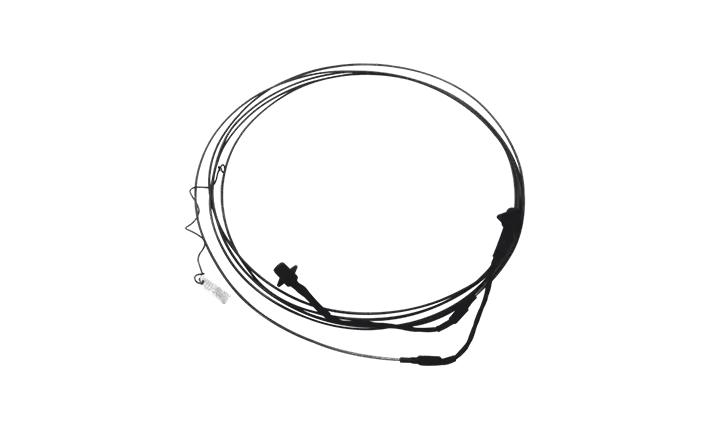
Instead of observing a protected area from a single optical point, the Continuous Heat Sensor follows the surfaces and equipment where heat development must be monitored. This allows temperature changes to be tracked along the installed sensing line and makes the system particularly useful in narrow, obstructed or mechanically complex spaces.
The supplied technical material specifies fire detection within 5 to 20 seconds, depending on fire magnitude, class and ignition point. Detection thresholds can be configured from 50°C to 250°C, while temperature information can be transmitted to the associated control unit for monitoring and alarm functions.
Continuous Sensing Without Line-of-Sight Dependence
The sensing wire is positioned directly across or around the zone that requires protection. As temperature changes occur, the system provides continuous thermal information rather than relying on visual access to a flame. This arrangement supports installations where machinery, panels, engine structures or confined geometries can obstruct conventional optical coverage.
In addition to fire-related temperature detection, the source states that the system can measure ambient temperature. Its sensing architecture is therefore suited to applications where persistent thermal supervision is required around high-temperature or fire-sensitive components.
Monitoring K-Type
6 mm
Built for High-Temperature and Complex Installations
The source identifies a K-Type thermocouple measurement structure with a 6 mm sensor thickness and Inconel coating. The sensing line has an elastic structure intended to support routing across demanding equipment layouts and protected surfaces.
The technical description also states that temperature changes can continue to be detected even if the sensing wire is cut, and that the construction provides resistance to chemical action. These characteristics support use in installations exposed to mechanical, thermal and environmental stress.
Continuous Heat Sensor Highlights
Continuous Thermal Monitoring
Temperature is monitored along the installed sensing line rather than at a single detection point.
Configurable Detection Threshold
Detection temperature can be configured between 50°C and 250°C according to application requirements.
5–20 Second Detection
The source specifies detection within 5 to 20 seconds depending on fire size, class and ignition location.
Inconel-Coated Construction
The 6 mm sensing element uses an Inconel coating for demanding thermal and operational environments.
Post-Activation Reuse
The supplied source describes the sensor as multi-use and capable of continuing operation after activation.
Flexible Installation
An elastic sensing structure supports installation around complex equipment, surfaces and confined geometries.
Continuous Temperature Sensing Approaches
Thermocouple-Based Sensing
- Principle
- Temperature is measured through electrical potential generated between dissimilar metals.
- Use
- Suited to high-temperature areas such as engines and exhaust systems.
- Product Data
- The supplied technical table identifies K-Type thermocouple measurement.
RTD-Based Sensing
- Principle
- Uses temperature-sensitive resistance elements to measure thermal change.
- Characteristic
- The source associates RTD sensing with high-precision temperature measurement and longer service life.
- Selection
- Sensor choice depends on temperature range, accuracy and application requirements.
Surface-Following Detection
- Placement
- The sensing line can be fastened directly to the surface or equipment requiring protection.
- Coverage
- Supports multi-structured zones where optical line-of-sight coverage is difficult.
- Monitoring
- Temperature data can be transferred to the associated control unit.
Application Areas
Test Standards & Technical References
The supplied product source lists aviation, military and thermal-detection references for the Continuous Heat Sensor. These references are presented here as stated in the source material without adding additional certification claims.
Frequently Asked Questions
01 What sensing technology is specified for the Continuous Heat Sensor?
The technical data identifies the measurement type as a K-Type thermocouple.
02 What material is used on the sensor's outer construction?
The supplied technical information specifies an Inconel coating and a sensor thickness of 6 mm.
03 Can the sensing line continue detecting temperature changes if it is cut?
Yes. The source states that the sensing line can continue to detect temperature changes even when the wire is cut.
04 Can the Continuous Heat Sensor be used again after an activation event?
The supplied product information describes the sensor as multi-use and states that it continues operation after activation.
05 Which qualification references are listed for the sensor?
The source lists DO-160, MIL-STD-810, SAE AS5420 and ASTM E2358 as test standards and technical references.
Technical Data
Need More Information About This System?
Contact our team for Continuous Heat Sensor specifications, installation requirements and application-specific fire detection configurations.