
Military Power Distribution Unit – PDU70
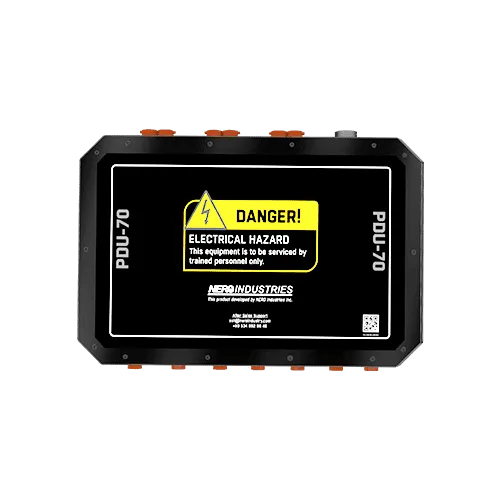 PDU70 / HIGH-VOLTAGE POWER DISTRIBUTION
Military Power Distribution Unit – PDU70
Military Power Distribution Unit – PDU70 is a compact intelligent power-management unit developed for electric and hybrid military platforms. It receives high-voltage AC or DC power from primary sources and distributes it to multiple vehicle subsystems while integrating monitoring, protection and communication functions for mission-critical electrical architectures.
High-voltage distribution, monitoring and protection architecture for electric and hybrid military vehicle systems.
Controlled High-Voltage Distribution for Military Electrical Architectures
The Military Power Distribution Unit – PDU70 manages electrical power within electric and hybrid military platforms. High-voltage AC or DC power received from primary sources is routed to multiple subsystems with different electrical requirements through a controlled distribution architecture.
Integrated monitoring and protection functions support controlled energy flow and electrical-system integrity under demanding military operating conditions.
Power Management Across Electric and Hybrid Military Platforms
PDU70 is intended for medium and heavy-duty electric and hybrid military vehicles and for military systems requiring high-voltage power distribution and energy control. Supplied deployment examples include ground vehicles, naval platforms, support vehicles, mobile systems and military installations.
The described architecture is intended for land, sea and mobile environments where electrical equipment may be exposed to vibration, temperature variation and electromagnetic interference.
Support1000
VDC
Configurable High-Voltage Input and Output Architecture
PDU70 supports configurable multiple high-voltage power inputs and outputs, with the supplied product information specifying operation up to 1000 VDC. Isolated voltage measurement is integrated at both input and output stages for high-voltage line monitoring.
Electrical protection functions include HVIL architecture, interlock-controlled battery relay outputs, fuse-protected outputs and protection against overvoltage, undervoltage, overcurrent and over-temperature conditions.
PDU70 Functional Features
HVIL Architecture
High-voltage interlock functions support controlled management of high-voltage connections.
Isolated Voltage Measurement
Input and output stages include isolated voltage measurement for high-voltage monitoring.
Pre-Charge Circuits
Pre-charge circuitry is included on all high-voltage outputs according to the supplied system description.
DC Bus Energy Sinking
Passive and active DC bus energy-sinking mechanisms are incorporated into the architecture.
Earth Insulation Monitoring
The unit monitors insulation conditions within the high-voltage electrical architecture.
Low Power Mode
A low-power operating mode supports reduced system consumption during inactive states.
Vehicle Control, Status Messaging and Diagnostics
SAE J-1939 CAN
- Protocol
- SAE J-1939 CAN.
- Data Rate
- 250 kbit/s.
- Status Cycle
- 100 ms.
Command Supervision
- Command Interval
- 100 ms expected interval.
- Command Timeout
- 400 ms.
- Timeout Response
- Emergency output asserted while operational state is maintained.
RS422 Diagnostics
- Interface
- RS422.
- Direction
- One-way transmission.
- Function
- Diagnostic and status data transmission to recording or monitoring devices.
Operational Applications
Centralized Distribution and Protection for Traction and Auxiliary Loads
PDU70 distributes high-voltage electrical power across traction and auxiliary systems within electric and hybrid military platforms. Its architecture combines power routing, monitoring, protection and communication functions within a single unit.
Protection against voltage, current and temperature faults is combined with pre-charge management, insulation monitoring and communication supervision to support coordinated operation within complex vehicle electrical systems.
Electrical, Environmental, EMC and Shock References
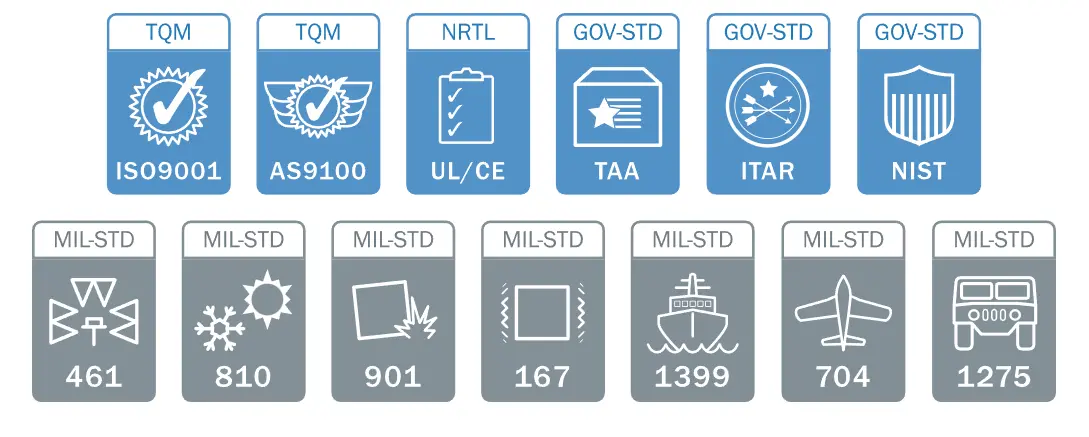
The supplied product information states that PDU70 is certified according to the following military standards covering electrical power characteristics, environmental durability, electromagnetic compatibility and shock resistance.
Frequently Asked Questions
01How frequently does PDU70 transmit cyclic CAN status messages?
The supplied system description specifies cyclic status transmission every 100 ms.
02What electrical fault conditions are covered by the PDU70 protection architecture?
The described protection functions include overvoltage, undervoltage, overcurrent and over-temperature conditions.
03Does PDU70 include pre-charge management on its high-voltage outputs?
Yes. The supplied information states that pre-charge circuits are provided on all high-voltage outputs.
04How does the unit manage residual DC bus energy?
PDU70 incorporates passive and active DC bus energy-sinking mechanisms.
05Is insulation supervision included in the high-voltage architecture?
Yes. Earth insulation monitoring is listed among the PDU70 system functions.
Technical Data
Need More Information About the Military Power Distribution Unit – PDU70?
Contact our team for PDU70 high-voltage distribution, protection, communication and platform-integration requirements.