
Laser Guided Drone
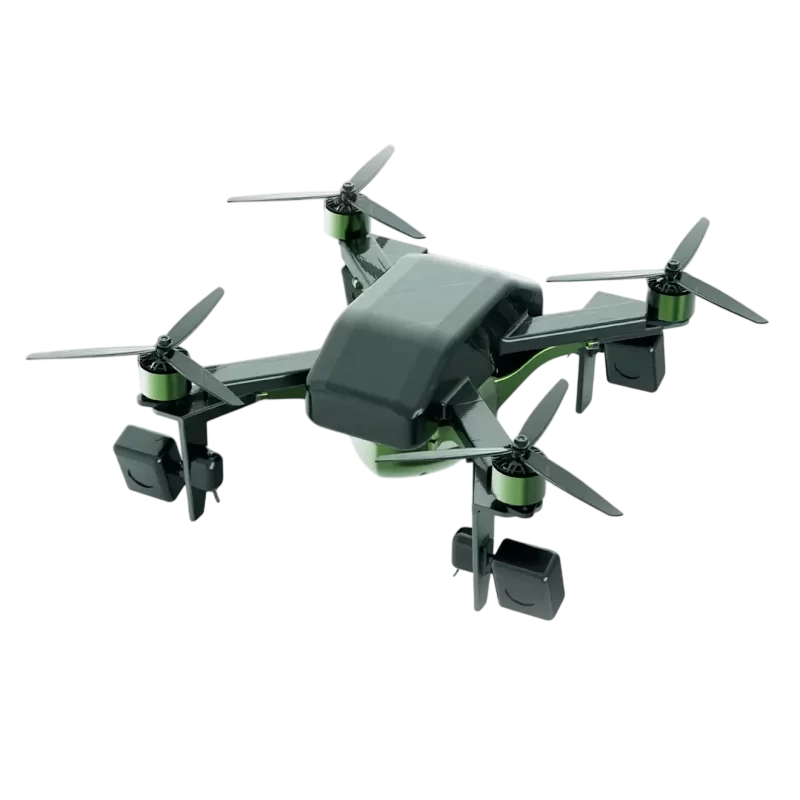 GLD-468 / LASER GUIDED DRONE
Laser Guided Drone
The Laser Guided Drone is a high-speed FPV unmanned aerial platform developed for precision-guided missions where accuracy, resistance to interference and operational reliability are critical. Using laser beam riding guidance technology, the system follows laser designation without reliance on conventional radio-navigation methods.
Reusable laser-guided FPV platform with automatic laser reacquisition and real-time first-person-view capability.
Laser Beam Riding Guidance for Precision Missions
The operational role of the Laser Guided Drone is to deliver precision-guided payloads to designated targets using laser guidance.
By following a laser beam projected from a compatible designator, the drone maintains a direct and controlled flight path toward the designated target, supporting accurate terminal guidance throughout the mission.
Military and Tactical Precision-Engagement Applications
The Laser Guided Drone is intended for military and tactical operations requiring precision engagement and payload delivery. Typical use cases identified in the supplied product information include direct-strike missions, reconnaissance-supported engagements and missions where reusable unmanned platforms are preferred over single-use munitions.
The system is intended for environments where conventional guidance methods may be degraded or denied.
Designator 1064 nm
Laser Beam Riding Guidance Architecture
The medium-class laser-guided FPV platform operates using laser beam riding guidance technology. Guidance is maintained through continuous detection of the laser signal, with automatic reacquisition if the beam is temporarily lost.
The system is compatible with a 1064 nm laser designator through its Laser Seeker Module. Real-time first-person-view capability supports situational awareness during operation.
Laser-Guided FPV Platform Features
Laser Beam Riding Guidance
The platform follows a laser beam projected from a compatible designator rather than relying on conventional radio-navigation guidance.
Automatic Laser Reacquisition
If the laser signal is temporarily interrupted, the system is designed to automatically detect and reacquire the beam.
1064 nm Compatibility
The Laser Seeker Module is compatible with a 1064 nm laser designator.
Real-Time FPV
Real-time first-person-view capability supports operator situational awareness during operation.
Plug-and-Play Architecture
The supplied product information describes plug-and-play deployment without complex setup or extensive operator training.
Reusable Platform
The unmanned platform is described as reusable depending on mission execution and recovery conditions.
Small, Medium and Large Platform Options
Small Configuration
- Payload
- 2–4 kg
- Range
- 3 km
- Top Speed
- 40 m/s
Medium Configuration
- Payload
- 4–6 kg
- Range
- 4 km
- Top Speed
- 40 m/s
Large Configuration
- Payload
- 6–8 kg
- Range
- 5 km
- Top Speed
- 40 m/s
Operational Mission Applications
Medium-Class FPV Drone Performance
The descriptive product information identifies the Laser Guided Drone as a medium-class FPV platform capable of carrying 4–6 kg payloads and reaching maximum speeds of up to 160 km/h.
Separately, the supplied technical data table lists the GLD-468 maximum speed as up to 180 km/h. Both source-provided values are retained in their respective contexts without reconciliation.
Continuous Laser Detection and Automatic Reacquisition
Guidance is maintained through continuous detection of the laser signal. If the beam is temporarily lost, the supplied product information states that the system can automatically detect and reacquire the laser signal.
Laser-based guidance is described as independent of traditional radio-based command links, supporting operation in environments where electronic interference or jamming affects conventional guidance methods.
Environmental and Electromagnetic Validation
The supplied product information states that the Laser Guided Drone is validated according to MIL-STD-810H for environmental durability and MIL-STD-461G for electromagnetic compatibility.
These standards are identified in the source as the validation framework for performance under demanding environmental and electromagnetic conditions.
Reusable Laser-Guided Precision Engagement
Functionally, the Laser Guided Drone provides a reusable precision-engagement capability with resistance to electronic countermeasures as described in the supplied product information.
Laser beam riding guidance enables controlled navigation independent of traditional radio-based command links, while the reusable platform concept supports repeatable mission execution subject to mission and recovery conditions.
Frequently Asked Questions
01 How is the Laser Guided Drone guided during flight?
The system follows a laser beam projected from a compatible designator using laser beam riding guidance.
02 Is the Laser Guided Drone affected by electronic jamming?
The supplied product information states that guidance is laser-based and does not rely on radio-frequency control links.
03 What payload range does the Laser Guided Drone support?
The main platform specification states payload capacity up to 6 kg, while the supplied configuration table lists Small at 2–4 kg, Medium at 4–6 kg and Large at 6–8 kg.
04 Can guidance be recovered if the laser signal is lost?
Yes. The supplied information states that the system automatically detects and reacquires the laser beam if an interruption occurs.
05 Is the Laser Guided Drone a single-use platform?
No. The drone is described as unmanned and reusable depending on mission execution and recovery conditions.
Technical Data
Immune to jamming and electronic interference
Supports precision strike and reconnaissance missions
(1064 nm laser designator compatible)
No complex setup or pilot training required
Range: 3 km
Top Speed: 40 m/s
Range: 4 km
Top Speed: 40 m/s
Range: 5 km
Top Speed: 40 m/s
MIL-STD-461G
Need More Information About the Laser Guided Drone?
Contact our team for product documentation, platform configuration information and system-integration requirements.