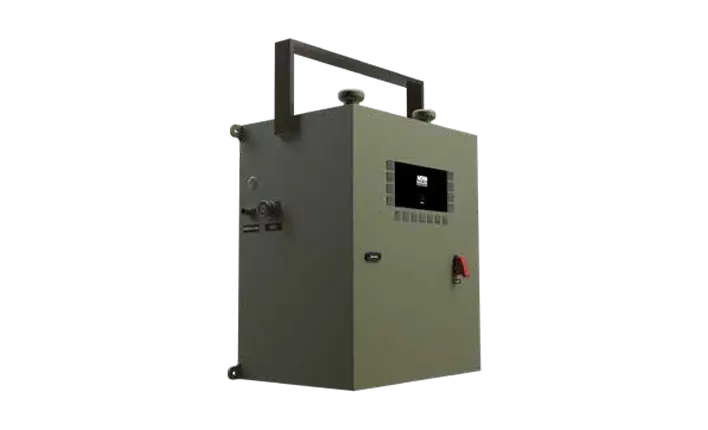
Chemical Detection Device
 CHEMICAL DETECTION / FTIR SPECTRAL ANALYSIS
Chemical Detection Device
Chemical Detection Device is designed to provide real-time detection, identification and warning of chemical threats using advanced optical spectroscopy techniques. The system analyzes toxic gases through optical absorption, emission, scattering and rotation measurements to support chemical characterization in operational environments.
Continuous FTIR-based monitoring for chemical warfare agents, toxic industrial chemicals and additional hazardous gas conditions.
Infrared Spectral Detection of Chemical Threats
The Chemical Detection Device is developed to detect and identify chemical warfare agents and toxic industrial chemicals by analyzing their infrared spectral signatures.
Through continuous ambient-air monitoring, the system provides early warning when hazardous chemical concentrations exceed predefined safety thresholds.
Fixed and Mobile Chemical Threat Monitoring
The device is deployed in military vehicles, shelters, command centers, border security points and critical infrastructure areas where chemical threat monitoring is required.
It is suitable for both fixed and mobile CBRN detection applications supporting operational safety and situational awareness.
Method FTIR
Optical Spectroscopy with Fourier Transform Infrared Analysis
The system operates using optical spectroscopy combined with a Fourier Transform Infrared (FTIR) measurement approach. Filtered infrared light is transmitted through an optical filter array to corresponding photodetectors, where transmitted optical power is recorded.
Measured data is processed using an RLS-based algorithm that estimates the incident spectrum from known filter transfer spectra and dynamically reconfigures both filter-transfer characteristics and the infrared light-source spectrum of the FTIR system.
Spectral Measurement and Chemical Identification Features
FTIR-Based Spectral Analysis
Infrared spectral signatures are analyzed using optical spectroscopy combined with a Fourier Transform Infrared measurement approach.
Optical Filter Array
Filtered infrared light is transmitted through an optical filter array to corresponding photodetectors for optical-power measurement.
RLS-Based Spectrum Estimation
An RLS-based algorithm estimates the incident spectrum using known filter transfer spectra and dynamically reconfigures measurement parameters.
Spectral Matching Library
A dedicated algorithm compares measured spectra with stored reference spectra for chemical warfare agents and toxic industrial chemicals.
Continuous Ambient-Air Monitoring
The system continuously evaluates ambient air to support real-time chemical-threat detection and concentration assessment.
Automatic Threshold Alarms
Warnings are automatically generated when detected chemical concentrations exceed configured or predefined threshold values.
Toxic Industrial Chemicals and Chemical Warfare Agents
Toxic Industrial Chemicals
- 01
- Ammonia
- 02
- Arsine
- 03
- Carbon Disulfide
- 04
- Hydrogen Cyanide
Toxic Industrial Chemicals
- 05
- Nitric Acid
- 06
- Cyanogen Compounds
- 07
- Phosphorus Trichloride
- 08
- Sulfur Dioxide
Chemical Warfare Agents
- Nerve
- GA, GB, GD, GF, VX
- Blister
- HD and L
- Alarm
- Automatic Threshold Warning
Operational Applications
Reference-Library Chemical Identification
A dedicated spectral-matching algorithm compares the measured infrared spectrum with reference spectra stored in the system library.
The internal library includes chemical warfare agents and toxic industrial chemicals, enabling identification based on the measured spectral signature.
VOC, VVOC, LEL and Gas-Level Alerts
In addition to the listed toxic industrial chemicals and warfare agents, the system provides alerts for volatile organic compounds (VOCs), very volatile organic compounds (VVOCs), lower explosive limit conditions and oxygen concentration levels.
The supplied information also identifies sulfur dioxide and phosphate gases within the additional monitoring and warning scope.
Optical Measurement and Real-Time Chemical Analysis
The supplied product information does not identify a specific NATO, MIL-STD or civilian certification for the Chemical Detection Device. Its stated detection architecture is based on optical spectroscopy, FTIR measurement, algorithmic spectrum estimation and reference-spectrum matching.
This framework supports continuous chemical monitoring, identification and automatic warning when measured concentrations exceed defined thresholds.
Real-Time Chemical Identification and Alarm Generation
The Chemical Detection Device continuously analyzes ambient air and identifies hazardous chemical substances through spectral comparison and concentration evaluation.
Real-time detection, classification and alarm generation across the stated chemical-agent range support early warning, threat assessment and protective response in chemical-hazard environments.
Frequently Asked Questions
01 Which detection principle is used by the Chemical Detection Device?
The system uses optical spectroscopy combined with FTIR-based spectral analysis to detect and identify chemical substances.
02 What types of chemicals can the system detect?
It detects chemical warfare agents, toxic industrial chemicals, VOCs, VVOCs, LEL conditions, oxygen levels, sulfur dioxide and phosphate gases.
03 How are detected chemicals identified?
Measured infrared spectra are compared with reference spectra stored in the system library using a dedicated spectral-matching algorithm.
04 Does the system provide automatic alarms?
Yes. The system automatically generates warnings when detected chemical concentrations exceed predefined or configured threshold values.
05 Is the system suitable for continuous monitoring?
Yes. It is designed for continuous real-time monitoring in both fixed and mobile CBRN detection applications.
Technical Data
Need More Information About the Chemical Detection Device?
Contact our team for FTIR chemical-detection integration, fixed or mobile CBRN monitoring, communication interfaces and application-specific detection requirements.