
Fire Extinguisher Simulator
 SIMULATOR / SYSTEM TESTING
Fire Extinguisher Simulator
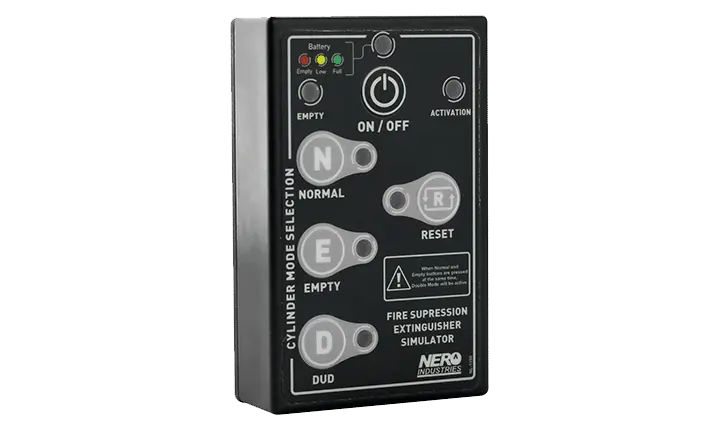
Testing a fire suppression or explosion suppression system should not require consuming the extinguishing cylinders reserved for operational use. The Fire Extinguisher Simulator electronically represents the connected cylinder interfaces so activation logic and system behavior can be checked without discharging actual extinguishing hardware. It supports repeatable verification during installation, commissioning, maintenance and troubleshooting.
Electronic test device for simulating extinguishing-cylinder interfaces without consuming operational cylinders during system verification.
Electronic Cylinder Simulation for Suppression System Testing
The Fire Extinguisher Simulator is connected to the cylinder interfaces of a fire extinguishing or explosion suppression system to reproduce the electrical behavior required for functional testing. This allows the system response to be evaluated while the actual extinguishing cylinders remain unused.
The simulator is intended for repeatable checks during installation, commissioning, maintenance and fault-finding activities where operational hardware should be preserved.
Rechargeable Internal Power with Type-C Supply Option
The simulator can operate from its internal 1200 mAh rechargeable battery or through a 5 VDC Type-C power input. This dual power arrangement supports testing both where an external supply is available and during field work where portable operation is required.
The supplied information describes the battery configuration as suitable for extended field testing without continuous dependence on an external power source.
LogicSingle
/ Double
Two Operating Modes for Different Cylinder Activation Architectures
Two selectable operating modes allow the device to simulate Single-Shot and Double-Shot system configurations. This enables verification of both single-cylinder activation logic and systems using redundant cylinder activation arrangements.
Dedicated control buttons and indicator LEDs provide the interface for selecting the required simulation behavior and observing device status during the test sequence.
Fire Extinguisher Simulator Highlights
Cylinder Interface Simulation
Allows suppression-system functionality to be checked without deploying actual extinguishing cylinders.
1200 mAh Rechargeable Battery
An internal rechargeable battery supports portable testing in field and on-site environments.
5 VDC Type-C Input
The simulator can also be powered through a 5 VDC Type-C connection when an external supply is preferred.
Single-Shot / Double-Shot Modes
Two operating modes reproduce different cylinder activation configurations for functional verification.
Optional BNC Monitoring Outputs
Optional oscilloscope interfaces provide access to activation and pressure signals for detailed analysis.
LED Status Feedback
Labeled indicators display power, activation, pressure and fault states during system testing.
Simulation, Signal Monitoring and Operator Feedback
Suppression Simulation
- Interface
- Connects to system cylinder interfaces.
- Modes
- Single-Shot and Double-Shot simulation.
- Purpose
- Functional verification without using operational extinguishing cylinders.
Signal Analysis
- Connection
- Optional BNC oscilloscope outputs.
- Signals
- Activation and pressure signals.
- Use
- Detailed observation of system responses during test procedures.
Status Interface
- Controls
- Dedicated operating buttons.
- Indication
- LED status feedback.
- States
- Power, activation, pressure and fault conditions.
Application Areas
Frequently Asked Questions
01What is the capacity of the simulator’s internal rechargeable battery?
The internal rechargeable battery is specified at 1200 mAh.
02What external power connection is available for the device?
The simulator supports a 5 VDC Type-C power input in addition to its internal battery.
03What is the difference between the two selectable simulation modes?
The modes reproduce Single-Shot and Double-Shot configurations, allowing single or redundant cylinder activation logic to be evaluated.
04Which conditions can be observed through the device indicators?
The supplied information identifies indication for power status, activation signals, pressure status and fault conditions.
05Which signals are available through the optional oscilloscope interfaces?
The optional BNC outputs are described for monitoring activation signals and pressure signals during system testing.
Technical Data
Need More Information About the Fire Extinguisher Simulator?
Contact our team for suppression-system verification, simulation modes and signal-monitoring requirements.