Fire Suppression System Control Box ARES SLX
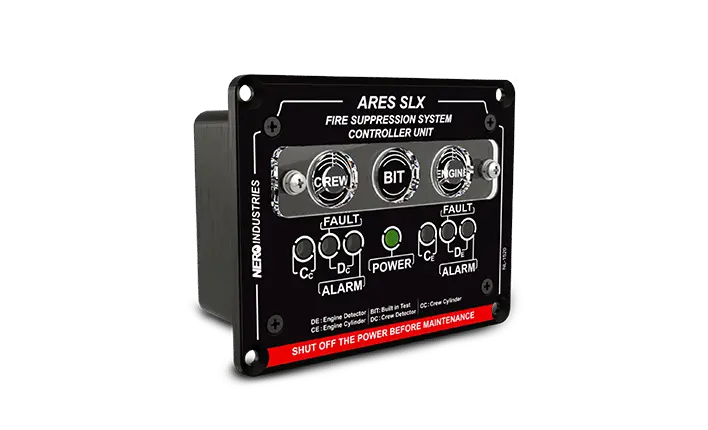 ARES SLX / CONTROL UNIT
Fire Suppression System Control Box ARES SLX
Modern military vehicles and explosion-prone platforms require intelligent control systems capable of managing fire suppression and explosion suppression responses in milliseconds. In high-risk environments, the effectiveness of a fire suppression system depends not only on detectors and extinguishing agents, but also on a reliable control unit that can coordinate all components seamlessly. The Fire Suppression System Control Box – ARES SLX is designed to meet these mission-critical requirements.
Centralized control and monitoring for vehicle fire extinguishing and explosion suppression architectures.
Central Coordination for Fire and Explosion Suppression
ARES SLX provides a centralized control point for suppression architectures installed on military vehicles and other high-risk platforms. It receives detection inputs from protected areas and coordinates the relevant suppression response through the connected system components.
Its multi-zone structure supports supervision of areas such as the power group, vehicle body, tires, engine compartment and crew compartment, while additional protection zones can be incorporated according to the platform configuration.
From Detection Input to Coordinated Suppression Response
The control unit continuously evaluates signals from connected detection devices and manages the suppression sequence when a fire or explosion condition is identified. Automatic activation is supported for rapid system response, while manual activation provides an additional control option when intervention is required by the operator.
ARES SLX also incorporates built-in-test functionality for system verification. This allows the control architecture to check connected functions and support continuous readiness while the platform is operating.
Control CANBUS
+ BIT
Vehicle-Level Communication and System Status Management
CANBUS communication enables alarm, fault and operating-status information to be transmitted between ARES SLX and the vehicle's main electronic system. Dedicated monitoring channels allow detector and suppression-cylinder status to be incorporated into the control process.
Visual indicators provide local information for power, detection, warning and fault conditions, giving operators a direct view of key system states at the control unit.
ARES SLX System Highlights
Automatic & Manual Activation
Supports automatic suppression response from detection inputs together with manual activation when required.
Built-In Test Function
Integrated BIT functionality supports verification of the suppression system and its connected functions.
CANBUS Communication
Alarm, fault and system-status information can be transmitted to the vehicle's main computer through CANBUS.
Multi-Zone Monitoring
The control architecture can process detection information from multiple protected areas within the platform.
IP67 Enclosure
The specified IP67 protection level supports operation where dust and water ingress protection is required.
Remote Control Option
An optional remote control panel can extend system management according to platform integration requirements.
Core Roles Within the Suppression System
Detection Input Management
- Inputs
- Receives information from connected fire and explosion detection sensors.
- Zones
- Supports supervision across multiple protected vehicle areas.
- Evaluation
- Processes detection conditions before initiating the relevant suppression sequence.
Suppression Activation
- Modes
- Supports automatic and manual activation.
- Components
- Coordinates connected suppression elements including cylinders and associated activation hardware.
- Control
- Centralizes the response sequence within the suppression architecture.
Status & Vehicle Interface
- Communication
- CANBUS provides data exchange with vehicle electronics.
- Verification
- Built-in-test functionality supports system checks.
- Indication
- Visual indicators communicate power, detection, warning and fault states.
Application Areas
Referenced Test Standards
The supplied technical material associates ARES SLX with standards addressing environmental durability, vehicle-material fire behavior, electrical disturbances and fire suppression system requirements. The references below are retained exactly as provided.
Frequently Asked Questions
01What input voltage range is specified for ARES SLX?
The control unit is specified for 24 VDC nominal power with a 16–32 V operating range.
02What is the specified current consumption at nominal voltage?
The supplied technical data specifies 450 mA at 24 VDC.
03What are the physical dimensions of the control box?
ARES SLX is specified at 85 × 40 × 110 mm (±5 mm).
04What operating temperature range is listed for ARES SLX?
The supplied data lists an operating temperature range of -51°C to +120°C.
05Can system management be extended beyond the main control box?
Yes. The supplied product information identifies an optional remote control panel for extended system management.
Technical Data
Need More Information About ARES SLX?
Contact our team for ARES SLX integration requirements, control architecture details and application-specific fire or explosion suppression configurations.