Fire Suppression System Control Unit ARES III
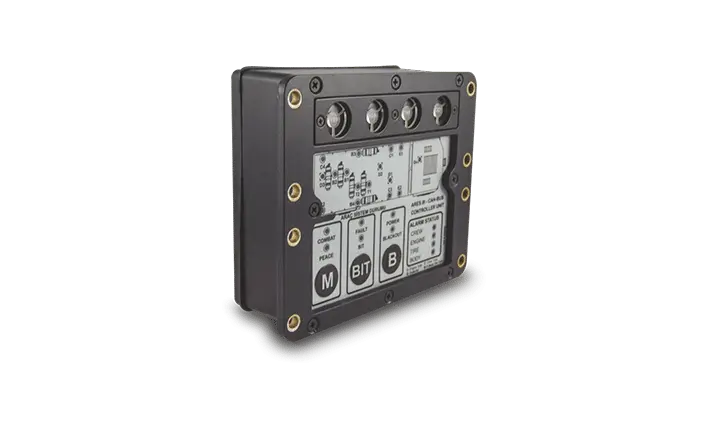 ARES III / CONTROL UNIT
Fire Suppression System Control Unit ARES III
ARES III is a configurable fire suppression system control unit developed for vehicle fire extinguishing and explosion suppression architectures. It receives detection inputs from multiple protected zones, coordinates suppression functions, and provides dedicated monitoring for detectors, cylinders, alarms and system faults. Its programmable structure supports complex military vehicle layouts where rapid response, multi-zone control and detailed system supervision are required.
Programmable multi-zone control for detector inputs, suppression cylinders, vehicle operating modes and system-status communication.
Programmable Multi-Zone Suppression Control
ARES III centralizes the monitoring and activation logic of vehicle fire extinguishing and explosion suppression systems. The unit can supervise multiple protected zones and coordinate detectors, cylinders and system outputs through a programmable control architecture.
The supplied technical data identifies support for 12 programmable detectors and 12 suppression cylinders, allowing the system to be configured around different crew, engine, tire and body protection requirements.
Fast Detection Processing and Suppression Activation
ARES III is specified with a reaction time of < 6 ms. When valid detection information is received, the control unit processes the relevant input and manages the required suppression response according to the programmed vehicle configuration.
The system supports automatic and manual control functions, while built-in test capability and vehicle operating modes provide additional control over readiness, verification and platform use.
Architecture12 DET.
12 CYL.
Dedicated Detector and Cylinder Management
The technical configuration supports up to 12 programmable detectors and 12 cylinders. The listed cylinder arrangement is Crew (4), Engine (2), Tires (2), Body (4), enabling separate suppression coverage for critical vehicle zones.
Supported detector inputs include optical detectors, thermocouples and thermal wire, allowing different detection technologies to be integrated within the same control architecture.
ARES III System Highlights
< 6 ms Reaction Time
The supplied technical table specifies a control-unit reaction time below 6 milliseconds.
12 Programmable Detectors
Detector channels can be configured around the required protection layout of the vehicle.
12-Cylinder Capacity
The system supports twelve suppression cylinders distributed across crew, engine, tire and body zones.
4 Inputs / 4 Outputs
The technical data lists four inputs and four outputs, with output capability specified as 1A / 24 VDC.
Data Logging
The unit records the last 500 entries for system-event history and operational review.
Galvanic Isolation
The supplied specification lists galvanically isolated architecture with DC-DC isolation.
Core Functions Within the ARES III Architecture
Detection Management
- Capacity
- Up to 12 programmable detector channels.
- Detector Types
- Optical, thermocouple and thermal wire inputs are listed.
- Processing
- Detection inputs are evaluated against the programmed suppression configuration.
Suppression Output Control
- Cylinders
- Supports 12 suppression cylinders.
- Configuration
- Crew (4), Engine (2), Tires (2), Body (4).
- Double Shot
- The supplied technical data identifies double-shot capability for crew and engine zones.
System Supervision
- Logging
- Stores the last 500 entries.
- Isolation
- Galvanically isolated / DC-DC isolation architecture.
- Communication
- CANBUS supports transfer of alarm, fault and system-status information to vehicle electronics.
Application Areas
Military and Production Standards
The supplied ARES III technical data lists military environmental and electromagnetic standards together with PCB production and additional conformity references. The values below are retained exactly as provided.
Frequently Asked Questions
01How many detector channels can ARES III manage?
The technical specification lists 12 programmable detectors.
02How are the 12 suppression cylinders distributed?
The supplied configuration is Crew (4), Engine (2), Tires (2), Body (4).
03Which detector technologies can be connected to ARES III?
The listed detector inputs are optical, thermocouple and thermal wire.
04How much event history can the unit retain?
ARES III is specified to store the last 500 entries.
05Where is the double-shot function available?
The technical table lists the Double Shot Feature for Crew and Engine.
Technical Data
Need More Information About ARES III?
Contact our team for ARES III detector and cylinder configuration, vehicle integration requirements and application-specific fire or explosion suppression control.