Nozzle
 NOZZLE / DISCHARGE COMPONENT
Nozzle
Accurate agent distribution is a key part of an effective fire suppression layout. The Fire Extinguishing Nozzle is a compact discharge component developed to direct extinguishing media toward a defined protection zone with a controlled spray pattern. Its available cone geometries and construction options support integration into tactical, onboard and industrial suppression arrangements where discharge direction and coverage must be matched to the protected area.
Precision discharge component for directing compatible suppression agents through defined fog-cone or full-cone spray patterns.
Directed Suppression Agent Distribution
The Fire Extinguishing Nozzle forms the final discharge interface between the suppression system and the protected zone. Its internal geometry is designed to shape the outgoing agent into a controlled pattern so that discharge can be directed toward a localized hazard or distributed across a wider area.
Depending on the selected configuration, the nozzle can provide fog-cone or full-cone coverage with viewing angles between 90° and 180°. This allows the discharge arrangement to be selected according to compartment geometry and protection requirements.
Corrosion-Resistant Construction and Installation Alignment
Standard construction options identified in the supplied product information include AISI 304 stainless steel and brass alloy. A naturally corrosion-resistant surface supports use in demanding operational environments.
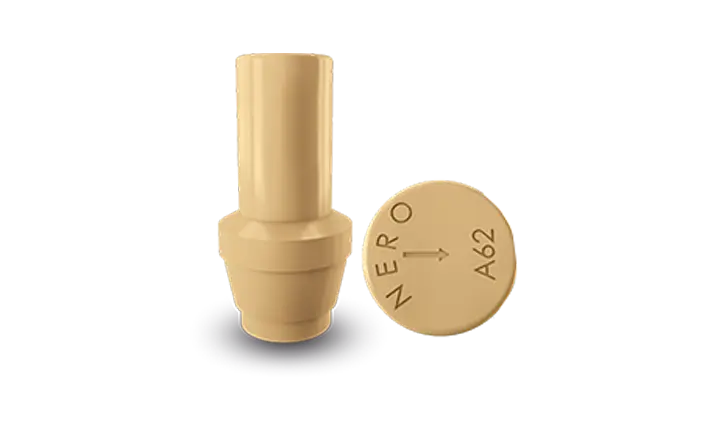
A mechanical alignment indicator arrow provides a visual reference during installation, helping the nozzle orientation correspond with the intended spray direction and coverage geometry.
Coverage90°–
180°
Configurable Spray Geometry for Different Protection Zones
The available nozzle configurations include 90°, 120°, 150° and 180° spray angles. Fog-cone and full-cone patterns allow the discharge profile to be matched to different fire suppression layouts.
For engine and tire applications, the supplied information also identifies special configurations using aluminum construction, a 3/8″ (9.525 mm) connection and a 120° full-cone spray pattern.
Fire Extinguishing Nozzle Highlights
Controlled Spray Pattern
Internal nozzle geometry directs the suppression medium into a defined discharge pattern for targeted coverage.
Multiple Spray Angles
Available viewing angles include 90°, 120°, 150° and 180° depending on the selected configuration.
5 / 6 mm Orifice Options
The internal orifice diameter is listed as 5 mm standard, with a 6 mm option.
50–60 L/min Nominal Flow
Nominal flow is stated as 50 to 60 liters per minute with water or compatible extinguishing agents.
Low Component Mass
The supplied product information identifies an approximate unit mass of 20 grams.
Alignment Indicator
A mechanical arrow assists with nozzle orientation during installation to support the intended spray direction.
Spray Pattern and Application Options
Fog Cone
- Pattern
- Fog-cone discharge geometry.
- Coverage Options
- Available across the supplied range of nozzle viewing angles depending on model.
- Purpose
- Supports dispersed agent delivery across a defined protection area.
Full Cone
- Pattern
- Full-cone discharge geometry.
- Angles
- Model configurations include 90°, 120°, 150° and 180° viewing angles.
- Integration
- Allows coverage geometry to be selected according to the protected compartment.
Engine & Tire Application
- Material
- Aluminum construction is identified for the special configuration.
- Connection
- 3/8″ (9.525 mm).
- Spray
- 120° full-cone pattern.
Application Areas
Frequently Asked Questions
01What internal orifice sizes are identified for the nozzle?
The supplied product information lists a 5 mm standard internal orifice and a 6 mm optional orifice.
02What nominal flow range is stated for water or compatible extinguishing agents?
The stated nominal flow range is 50–60 liters per minute.
03How does the installation alignment indicator assist positioning?
The mechanical indicator arrow provides an orientation reference so the installed nozzle can be aligned with the intended spray direction and coverage angle.
04What connection is identified for the special engine and tire configuration?
The special engine and tire configuration is described with a 3/8″ (9.525 mm) connection.
05What is the approximate mass of the standard nozzle unit?
The supplied information gives an approximate unit mass of 20 grams.
Technical Data
Need More Information About the Fire Extinguishing Nozzle?
Contact our team for nozzle configuration, spray-pattern selection and fire suppression system integration requirements.