
Laser Warning Control Unit – LWS-2
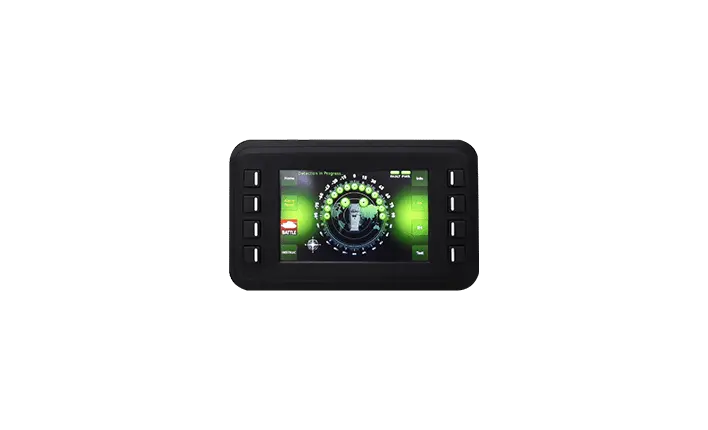 LWS-2 / DIGITAL CONTROL
Laser Warning Control Unit – LWS-2
Laser Warning Control Unit – LWS-2 is a compact digital control unit developed to manage and monitor laser warning systems on military and security vehicles. Designed for ease of use and rapid response, the unit provides centralized control, visualization and system verification through an integrated touch screen interface.
Compact touch-screen control, visualization and diagnostic management for vehicle-mounted laser warning systems.
Centralized Control and Visualization for Laser Warning Systems
LWS-2 is designed to control and manage laser warning systems installed on military platforms. By receiving and displaying laser threat data from connected sensors, the control unit supports operator awareness and enables effective system supervision during high-risk missions.
The compact digital architecture combines touch-screen interaction, real-time threat visualization, diagnostic capability and vehicle-system communication within a single control unit.
Where to Use / Deployment
The control unit is suitable for wheeled and tracked military vehicles, armored platforms and security vehicles operating in environments where laser-based threats are present.
Its compact structure allows installation in vehicle interiors without imposing significant layout constraints.
Interface Touch
Screen
System Interface and Control Capabilities
LWS-2 features a touch screen interface that allows users to switch easily between laser warning and smoke grenade system menus when integrated. The digital display presents an on-vehicle schematic, providing clear visualization of detected laser threats and sensor status.
The unit receives and displays laser warning system data including sensor status, detected laser angle, laser class and wavelength band information in real time to support rapid assessment and decision-making.
LWS-2 System Functions
Touch Screen Interface
Integrated touch-screen operation provides centralized access to laser warning and compatible smoke grenade system menus.
Vehicle Schematic Display
The digital interface presents an on-vehicle schematic for visualization of sensor locations and detected laser threat directions.
Real-Time Threat Data
Displays sensor status, detected laser angle, laser class and wavelength band information for operator assessment.
Built-In Test
Built-In Test functionality (BIT) allows users to verify system readiness prior to operation.
Smoke Grenade Control
When connected to compatible launcher systems, LWS-2 can control up to sixteen smoke grenades and manage two different smoke grenade types.
CANBus Integration
CANBus communication supports integration with compatible vehicle electronic architectures and other systems.
Control and Diagnostic Functions
Threat Visualization
- Display
- On-vehicle schematic
- Information
- Sensor status, laser angle, class and wavelength band
System Diagnostics
- Function
- Built-In Test (BIT)
- Controls
- Alarm reset, mode switching and system configuration
Countermeasure Interface
- Capability
- Controls up to 16 smoke grenades
- Smoke Types
- Two different smoke grenade types
Vehicle Platform Applications
System Functions and Diagnostics
The control unit includes a Built-In Test (BIT) function that allows users to verify system readiness prior to operation. Alarm reset, mode switching between operational states and system configuration are accessible through dedicated buttons and the touch interface.
LWS-2 is capable of controlling up to sixteen smoke grenades when connected to compatible launcher systems and can manage two different types of smoke grenades through the same interface.
Communication and Environmental Characteristics
The unit communicates with other vehicle systems via CANBus, enabling integration into existing electronic architectures. It operates within a specified temperature range of -32 / +49 °C and is designed with IP67 protection against water and dust ingress.
The supplied technical data also specifies a storage temperature range of -55°C / +85°C.
High-Reliability Electronic Assembly
LWS-2 electronic assemblies are manufactured according to IPC-A-610G Class 3 requirements. This production standard supports high-reliability workmanship for electronic assemblies intended for demanding and mission-critical operating environments.
Centralized Laser Warning Supervision
LWS-2 provides centralized control and visualization for laser warning systems, enabling operators to monitor laser threats, verify system status and manage countermeasure interfaces from a single control unit.
By combining intuitive user interaction, diagnostic capability and robust vehicle integration, the system enhances platform safety and operational effectiveness in laser-threat environments.
Frequently Asked Questions
01 What is the primary function of the LWS-2 Control Unit?
LWS-2 provides centralized control and monitoring of laser warning systems installed on military and security vehicles.
02 How does the operator interact with the system?
The system is operated through an integrated touch screen interface that allows easy menu navigation and system control.
03 Does LWS-2 provide visual representation of the vehicle?
Yes. The digital display shows an on-vehicle schematic indicating sensor locations and detected laser threat directions.
04 Does the unit include system diagnostics?
Yes. LWS-2 features a Built-In Test (BIT) function to verify system readiness before operation.
05 How does LWS-2 communicate with other vehicle systems?
The control unit uses a CAN-BUS communication interface for integration with vehicle electronic systems.
Technical Data
Need More Information About LWS-2?
Contact our team for LWS-2 laser warning system integration, vehicle compatibility and control-unit requirements.