
Linear Sensor Wire
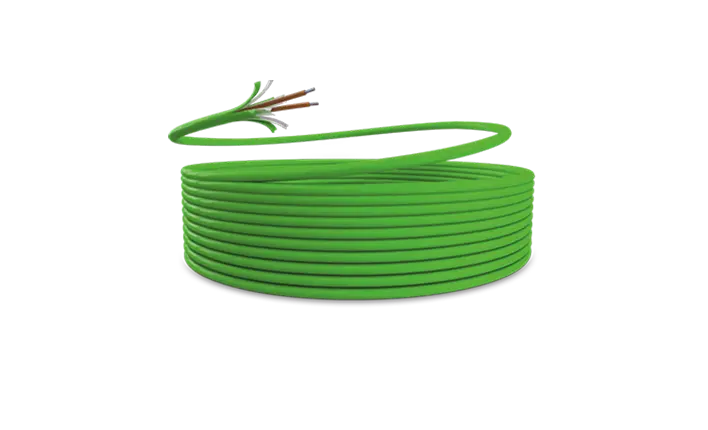 LINEAR / HEAT DETECTION
Linear Sensor Wire
Linear fire detection systems are essential for environments where fire risks can develop along extended surfaces rather than at a single point. In high-risk installations such as industrial facilities, tunnels, cable trays, and machinery lines, early and localized temperature-based detection provides a reliable alternative to optical systems. Linear Sensor Wire is designed to detect abnormal heat rise along its entire length, enabling effective fire detection in distributed and complex areas.
A fixed-line thermal detection solution developed for distributed fire risks across extended surfaces, equipment routes and confined infrastructure.
Heat Detection Across Extended Protection Zones
Linear Sensor Wire creates a continuous thermal detection path across the area being protected. Rather than concentrating detection at one point, the wire can be routed along equipment, infrastructure and other extended surfaces where abnormal heat may emerge at different locations.
The supplied product data specifies a typical detection period of 10 to 40 seconds, depending on the magnitude and class of the fire and the location of ignition. The system uses a physical temperature response in the wire to initiate an alarm signal when the relevant thermal condition is reached.
Alarm Generation Through Physical Thermal Response
The sensing wire is installed directly along the route or surface requiring fire supervision. According to the supplied source, when the surrounding temperature reaches approximately 180°C, the wire structure begins to deteriorate: the external layer melts and the internal conductors make contact, transmitting a fire alarm signal to the control unit.
This operating method does not depend on an unobstructed optical view of the ignition point. It therefore supports distributed layouts where heat can develop behind equipment, along cable routes, around machinery or across other areas that are difficult to supervise from a single detector position.
Detection 120 / 150
/ 170°C
Pre-Set Alarm Levels for Different Thermal Conditions
The technical table lists 120°C, 150°C and 170°C as the available pre-set alarm levels. This provides defined thermal trigger options for installations with different operating temperatures and fire-risk profiles.
The product is specified with a 6 mm wire gauge and a 150 mm bending radius. Its fixed-line format allows the sensing route to follow extended areas instead of limiting fire detection to isolated points.
Linear Sensor Wire Highlights
Continuous Line Coverage
The sensing route extends thermal supervision across the installed wire length instead of relying on a single detection point.
Defined Alarm Temperatures
Pre-set alarm levels of 120°C, 150°C and 170°C are listed in the supplied technical data.
10–40 Second Detection
Detection time is specified as 10 to 40 seconds depending on fire magnitude, class and ignition location.
Fixed-Line Installation
The wire can be positioned along surfaces and routes where distributed heat development needs to be detected.
Wide Temperature Range
The technical table specifies both operating and storage temperature ranges from -55°C to +170°C.
Complementary Detection Role
The source describes linear sensing as suitable for standalone use or as a complement to flame and smoke detection systems.
Temperature Detection Methods for Extended Areas
Thermistor & RTD Sensing
- Thermistor
- Uses temperature-related resistance changes in metal-oxide sensing materials.
- RTD
- Platinum-based resistance sensing can provide stable and accurate temperature measurement.
- Selection
- The appropriate method depends on the required accuracy and operating environment.
Fiber Optic Sensing
- Technology
- Temperature is measured through optical-fiber-based sensing principles.
- Application
- The source identifies fiber optic linear sensing for specialized temperature-monitoring applications.
- Coverage
- Its linear format supports temperature observation over extended routes.
Bimetallic Sensing
- Principle
- Thermally responsive metal elements deform as temperature changes.
- Signal
- The resulting mechanical response is used to initiate an electrical signal.
- Role
- Provides another linear thermal detection approach for fixed monitored routes.
Application Areas
Fire Detection Standards & References
The supplied source associates Linear Sensor Wire systems with recognized fire-detection and safety references. The standards below are reproduced from the provided technical material without adding further certification claims.
Frequently Asked Questions
01 What wire gauge is specified for the Linear Sensor Wire?
The supplied technical table specifies a 6 mm wire gauge.
02 What is the minimum specified bending radius?
The technical data lists a 150 mm bending radius for the Linear Sensor Wire.
03 What operating temperature range is listed for the sensor wire?
The specified operating temperature range is -55°C to +170°C.
04 Can Linear Sensor Wire complement other fire detection technologies?
Yes. The source describes linear sensor wire as suitable for standalone detection or as a complementary system alongside flame or smoke detectors.
05 Which fire detection references are associated with the product?
The supplied material lists EN 54-5, FM Approval Standard, UL 521 and BS 5839.
Technical Data
Need More Information About This System?
Contact our team for Linear Sensor Wire specifications, alarm-level options, installation requirements and application-specific fire detection configurations.