Triple IR Optical Detector
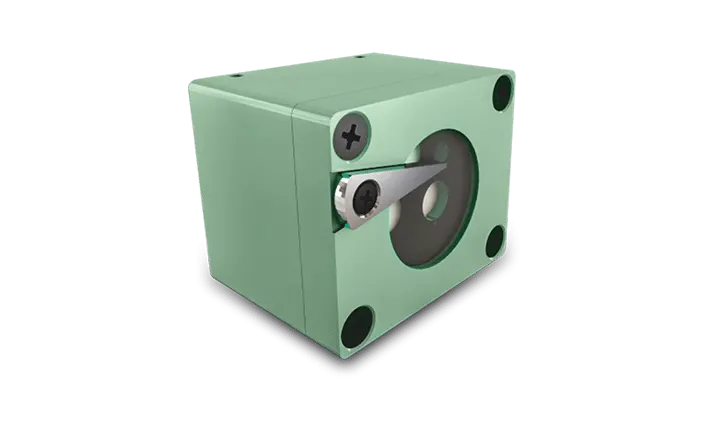 TRIPLE IR / FLAME DETECTION
Triple IR Optical Detector
Ultra-fast fire detection is critical where explosive threats, flammable materials or high-energy impacts can create a fireball within milliseconds. The Triple IR Optical Detector evaluates three infrared wavelength bands to deliver rapid flame recognition while rejecting common non-fire radiation sources in demanding military, industrial and energy-sector environments.
A multi-spectrum infrared flame detector developed for applications where fast fireball recognition and strong resistance to false alarms are essential to the protection strategy.
Three-Band Infrared Detection for Rapid Fire Events
Fireballs produced by fuel ignition, explosive threats or high-energy impacts can develop before conventional heat or smoke detection has time to respond. Triple IR technology addresses this challenge by evaluating flame-related radiation across three independent infrared wavelength bands.
The Triple IR Optical Detector is specified to detect the fireball associated with armor penetration within 3 milliseconds. An alarm is generated when the detector's three IR channels confirm the required flame signature, supporting rapid signaling to the connected control and suppression architecture.
Multi-Wavelength Confirmation with Advanced Signal Processing
The detector monitors IR1 at 4.5–5.5 μm, IR2 at 3.0–3.6 μm and IR3 at 0.8–1.2 μm. By comparing these separate infrared regions, the system can evaluate whether the observed radiation pattern is consistent with a genuine flame event.
The source documentation identifies ultra-fast semiconductor IR quantum sensors, two high-performance microprocessors and advanced software algorithms as part of the detection architecture. Requiring confirmation across all three IR channels helps reduce unwanted alarms from non-fire radiation sources.
Detection 3 IR
Bands
Fast Response with False-Alarm Rejection
Triple-band confirmation is used to separate real flame signatures from common optical and thermal interference. The supplied source specifically identifies immunity to sunlight and solar fluctuations, vehicle headlights, welding arcs, infrared heaters and cigarette ash.
The detector is also described as suitable for harsh environments, with IP67 protection. The source states that this level allows the detector to remain submerged under 1 meter of water for up to 30 minutes.
Triple IR Optical Detector Highlights
Sub-3 ms Fireball Detection
The product source specifies detection of an armor-penetration fireball within 3 milliseconds.
Three IR Wavelength Bands
IR1, IR2 and IR3 channels evaluate flame radiation across three separate infrared spectral regions.
Strong False-Alarm Immunity
Three-channel confirmation helps reject non-fire sources such as sunlight, headlights, welding arcs and infrared heaters.
Long-Range Detection
The supplied source lists a detection range exceeding 60 meters when the detector operates in high-sensitivity mode.
Multiple Interfaces
Communication options listed in the source include ModBus RS-485, analog output and relay interfaces.
Visual Status Indication
Green indicates energized status, red indicates alarm and yellow identifies a fault or error condition.
Triple IR Detection Architecture
IR1 Detection Band
- Wavelength
- 4.5–5.5 μm.
- Role
- One of three independent infrared channels used for flame-signature confirmation.
- Processing
- Evaluated together with IR2 and IR3 before alarm confirmation.
IR2 Detection Band
- Wavelength
- 3.0–3.6 μm.
- Role
- Provides a second spectral reference for differentiating flame radiation from interference.
- Processing
- Part of the detector's three-band confirmation logic.
IR3 Detection Band
- Wavelength
- 0.8–1.2 μm.
- Role
- Completes the three-channel infrared comparison used for flame recognition.
- Processing
- Alarm generation requires confirmation across all three IR sensors.
Application Areas
Testing Standards & Certification References
The supplied product content identifies NATO STANAG 4317 and MIL-PRF-62546C for the detector's military fire-detection context. It also lists EN 54-22, UL 268, FM Approval Standards and ISO 7240-24 under testing standards, together with FM approval, ATEX certification, CE marking and SIL 2 compatibility.
Frequently Asked Questions
01 Which infrared wavelength bands are monitored by the Triple IR Optical Detector?
The detector monitors IR1 at 4.5–5.5 μm, IR2 at 3.0–3.6 μm and IR3 at 0.8–1.2 μm.
02 How is a flame alarm confirmed across the detector's three IR channels?
The supplied product content states that an alarm is generated only when all three IR sensors simultaneously confirm a flame signature.
03 Which communication interfaces are listed for system integration?
The source lists ModBus RS-485, analog output and relay interfaces.
04 What do the detector's visual status indicators represent?
Green indicates energized status, red indicates alarm and yellow indicates a fault or error condition.
05 Which fire types are identified in the source as suitable detection targets?
The source identifies hydrocarbon fires involving petrol, methane, diesel and LPG, as well as paper, wood and solvent fires.
Technical Data
Need More Information About This System?
Contact our team for detector specifications, integration requirements and application-specific fire detection configurations.